Circular Economy in Agriculture and Horticulture: Bringing Plastics Back into the Loop
Exclusively for K-Mag
Reuse, Take-Back and Recycling in Practice

24.11.2026
There is no single way to keep plastics in circulation across agriculture and horticulture. While some products can be used repeatedly, others need to be collected and recycled after use. Which solutions are already being implemented – and what does it take to make them work?
At a glance
- Reuse in horticulture: Standardised transport trays for potted plants can be used repeatedly through organised return systems.
- Recycling irrigation lines: Collection of materials separated by type and subsequent processing enable recovered plastics to be used again.
- Agricultural plastics take-back: Joint collection schemes consolidate used materials from geographically dispersed agricultural operations.
According to estimates by the Food and Agriculture Organization of the United Nations (FAO), approximately 12.5 million tonnes of plastic products were used worldwide in agricultural production, including fisheries and forestry, in 2019 – excluding food packaging. These materials help protect crops, deliver water efficiently and reduce harvest losses, among other functions. What happens to them after use, however, depends largely on the application.
One particular challenge in agriculture and horticulture is that plastic products often remain outdoors for extended periods, where they are exposed to weathering and mechanical stress or come into contact with soil and plant residues. They are also used across widely dispersed locations. Take-back systems must therefore account not only for contamination and material ageing but also for the logistics of collecting used products from multiple sites.
What Determines Whether Plastics Can Be Kept in Circulation?
Whether reuse or recycling is the more suitable option depends on more than the type of plastic. Three factors are particularly important:
- Service life: Transport trays for potted plants can be used repeatedly, whereas some agricultural films are designed for just one growing season.
- Material condition: Contamination, ageing and multi-material structures can make reuse or recycling more difficult.
- Return logistics: Transport trays can be returned through organised supply chains. Used agricultural plastics, by contrast, often need to be consolidated at collection points.
Reuse in Horticulture: Keeping Plastic Products in Circulation
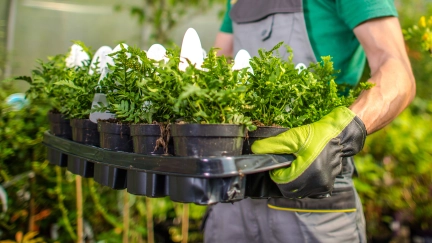
In commercial horticulture, potted plants are frequently transported in plastic trays between growers, wholesalers and retailers. Many of these transport trays are still used only once. Standardised reusable systems allow the trays to be returned, cleaned and used again after delivery.
The European reusable transport system Euro Plant Tray uses standardised polypropylene (PP) trays for potted plants, supported by an organised return logistics network. According to the German Federal Environmental Foundation (DBU), around two million trays were already in circulation across several European countries in 2026. According to the system operator, the trays contained 35% recycled material.
The trays are designed for a long service life and are intended to be recycled at the end of their useful life. Whether the system delivers environmental benefits in practice depends, among other factors, on the actual number of reuse cycles, transport distances and cleaning processes.
Irrigation Systems: Turning Used Pipes into Raw Materials
Plastic pipes used for agricultural irrigation present a different set of challenges. Drip irrigation systems deliver water directly to crops. Once their service life ends, however, the tubing and pipes must be collected and processed if the material is to be used again.
Irrigation specialist Netafim operates take-back and recycling programmes for this purpose. Through its ReGen programme, used drip irrigation lines are collected and processed, with the recovered plastic used to manufacture new irrigation lines, according to the company.
The published take-back requirements for individual programmes stipulate, among other things, that materials must be supplied as clean and separated by type as possible. Sufficient collection volumes also matter if transport and processing are to be practical.
This has a direct implication for plastics manufacturers and processors: Material recovery at the end of a product's service life should be considered from the design stage. Even readily recyclable plastics can only be used again if they reach recycling facilities in a suitable condition and quality.
Agricultural Films: Collecting Materials for Recycling
Recovering agricultural films is particularly challenging. After use, they may be contaminated with soil, moisture and plant residues. Used materials also arise at numerous geographically dispersed locations.
In Germany, the ERDE initiative (Erntekunststoffe Recycling Deutschland) organises the take-back of used agricultural plastics. Manufacturers, agricultural businesses, agricultural distributors, collection partners and recycling companies work together within a shared system.
According to the initiative, 37,342 tonnes of agricultural plastics were collected and sent for mechanical recycling in 2025. This figure represents the quantity collected through the scheme, not the recycling rate for all agricultural plastics used in Germany.
Further reading: Agricultural Plastics in the Circular Economy – on durability, recycling and biodegradable alternatives.
Key Learnings: Lessons for Other Industries
- Choose the right circular approach: Whether reuse or mechanical recycling is more suitable depends on a product's service life, material condition and how easily it can be recovered.
- Plan for collection and return: Collection, transport and processing must be part of the circularity strategy from the outset.
- Coordinate across the value chain: When products move between multiple companies or locations, clearly defined responsibilities and common standards are essential.
- Assess actual performance: Real-world reuse cycles, return rates and recycled material use are more meaningful indicators than technical recyclability alone.
Circularity Requires Collaboration
For the plastics industry, the challenge is to coordinate take-back and recycling processes with the companies using the products at an early stage. What stresses must a product withstand? How can it be recovered after use? And what quality must the recovered material achieve to be used again? Addressing these questions requires agreement on product design, return logistics and recycled material quality across the value chain.
Key Takeaway
Whether through reuse or recycling, circularity in agriculture and horticulture depends on more than the material itself. Equally important is how plastic products can be recovered after use and put back into circulation.
More Articles in the Series:
How can Circular Economy succeed across different industries? This series explores the specific challenges and solutions in a range of sectors. Articles on packaging, automotive manufacturing and consumer goods have already been published, with more industries to follow.
Author: Nadine Lormis | K-Mag
For more than 15 years, Nadine Lormis has been covering innovation, technological developments and societal challenges across a wide range of industries. For K-Mag, she explores current trends, sustainable concepts and future-oriented topics throughout the plastics and rubber industry's value chain.